How to Play Rummy: Rules, Scoring and Simple Strategy
Learn how to play classic Rummy with clear rules on dealing, melds, laying off and scoring, plus beginner strategy tips to help you go out first.
In this guide
Rummy is one of the most popular card games in America, and it is the parent of many variations, including Gin Rummy and Rummy 500. The basic version is easy to learn, plays well with two to six people and offers just enough strategy to keep things interesting.
What you need
- A standard 52-card deck (use two decks for five or more players if you prefer)
- Two to six players
- Pencil and paper for scoring
Card values
- Aces are low and worth 1 point.
- Number cards (2–10) are worth their face value.
- Face cards (Jack, Queen, King) are worth 10 points each.
In most basic Rummy rules, Aces are low only, so a run like A-2-3 is allowed but Q-K-A is not. Some families play Aces as high or low; agree before you begin.
The goal
Be the first player to get rid of all your cards by forming melds:
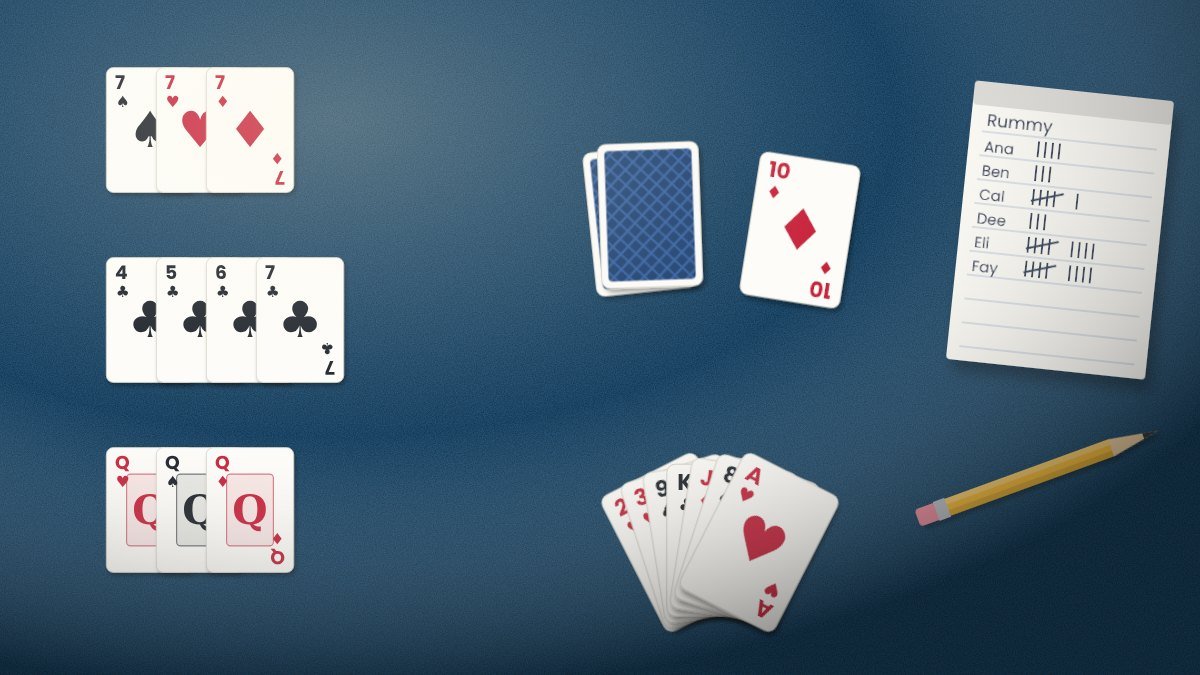
- Sets: three or four cards of the same rank, like 7♠ 7♥ 7♦.
- Runs: three or more consecutive cards of the same suit, like 4♣ 5♣ 6♣.
How to deal
The number of cards dealt depends on the number of players:
| Players | Cards per player |
|---|---|
| 2 | 10 |
| 3–4 | 7 |
| 5–6 | 6 |
Place the remaining cards face down as the stock. Turn the top card face up next to it to start the discard pile.
How a turn works
- Draw one card, either the top card of the stock or the top card of the discard pile.
- Meld (optional). Lay down any sets or runs you have, face up in front of you.
- Lay off (optional). Add cards from your hand to melds already on the table, yours or anyone else's. For example, if someone has laid down 8♥ 9♥ 10♥, you can add your J♥.
- Discard one card face up onto the discard pile. If you drew from the discard pile, you usually cannot discard that same card on the same turn.
If the stock runs out before anyone goes out, shuffle the discard pile (except the top card) to form a new stock.
Going out
A player goes out when they get rid of every card in their hand, either by melding, laying off or discarding their final card. The round ends immediately.
Scoring
When someone goes out, every other player adds up the value of the cards still in their hand. The winner of the round scores the total of all those points. Play continues over several rounds, and the first player to reach an agreed target, often 100 or 500 points, wins the game.
Some players use "rummy" bonuses: if you go out by melding your entire hand in one turn without having melded before, your points are doubled.
Beginner strategy tips
Discard high cards early
Face cards are worth 10 points each. If you are stuck holding them when someone else goes out, they will cost you. Unless you are close to completing a meld with them, get rid of high cards early in the round.
Watch the discard pile
The discard pile tells you a lot. If your opponent picks up a 9♦, they might be collecting nines or building a diamond run. Avoid discarding cards that help them.
Keep flexible cards
A card like 7♥ is valuable if you also hold 7♣ and 8♥, because it could finish either a set or a run. Hold onto cards that work in more than one possible meld.
Do not meld too early
Laying down melds feels good, but it also shows your opponents what you are collecting and gives them places to lay off cards. Sometimes holding your melds until you can go out in one or two turns is the smarter play.
Lay off whenever you can
Adding single cards to existing melds is an easy way to empty your hand, especially late in a round.
Popular variations
- Gin Rummy: A two-player version where you do not meld until the end of the hand.
- Rummy 500: Players also score points for their own melds, and the target is 500.
- Kalooki and Contract Rummy: Variations with specific meld requirements each round.
The bottom line
Rummy is easy to pick up and rewarding to play well. Draw, meld, lay off and discard, keep an eye on what your opponents collect and get rid of high cards early. After a few rounds, you will see why it has been a family favorite for generations.