A Beginner's Guide to Chess Openings: Principles, Not Memorization
New to chess? Learn the core principles behind good chess openings and four beginner-friendly openings for White and Black, without memorizing long move lists.
In this guide
The opening is the first stage of a chess game, usually the first 10 to 15 moves. Many new players think they need to memorize dozens of named openings and long move sequences. They do not. Learning a handful of simple principles will improve your games far more than memorizing lines you do not understand.
This guide explains those principles, then walks through a few beginner-friendly openings so you have something reliable to play with both colors.
A quick note on notation
Chess moves are written in algebraic notation. Each square has a name made of a letter (a through h, left to right from White's side) and a number (1 through 8, bottom to top). Pieces are written with capital letters: K for king, Q for queen, R for rook, B for bishop and N for knight. Pawns have no letter. So 1. e4 means White moves a pawn to e4 on move one, and Nf3 means a knight moves to f3.
The five opening principles
1. Control the center
The four center squares, d4, d5, e4 and e5, are the most important squares on the board. Pieces in the center control more squares and can move quickly to either side. That is why so many games start with 1. e4 or 1. d4.
2. Develop your pieces
"Developing" means moving your knights and bishops off their starting squares so they can join the game. A good habit is to bring out knights before bishops and to avoid moving the same piece twice early on unless you have a good reason.
3. Castle early
Castling moves your king to safety near the corner and brings a rook toward the center. Try to castle within your first 10 moves. Kings left in the middle of the board are easy targets.
4. Do not bring your queen out too early
The queen is your most powerful piece, but if you bring it out early, your opponent can chase it around with less valuable pieces and develop for free. Let your minor pieces lead.
5. Connect your rooks
Once your knights and bishops are developed and your king is castled, your two rooks should be able to "see" each other with nothing in between. That is a sign your opening is complete.
Openings for White
The Italian Game
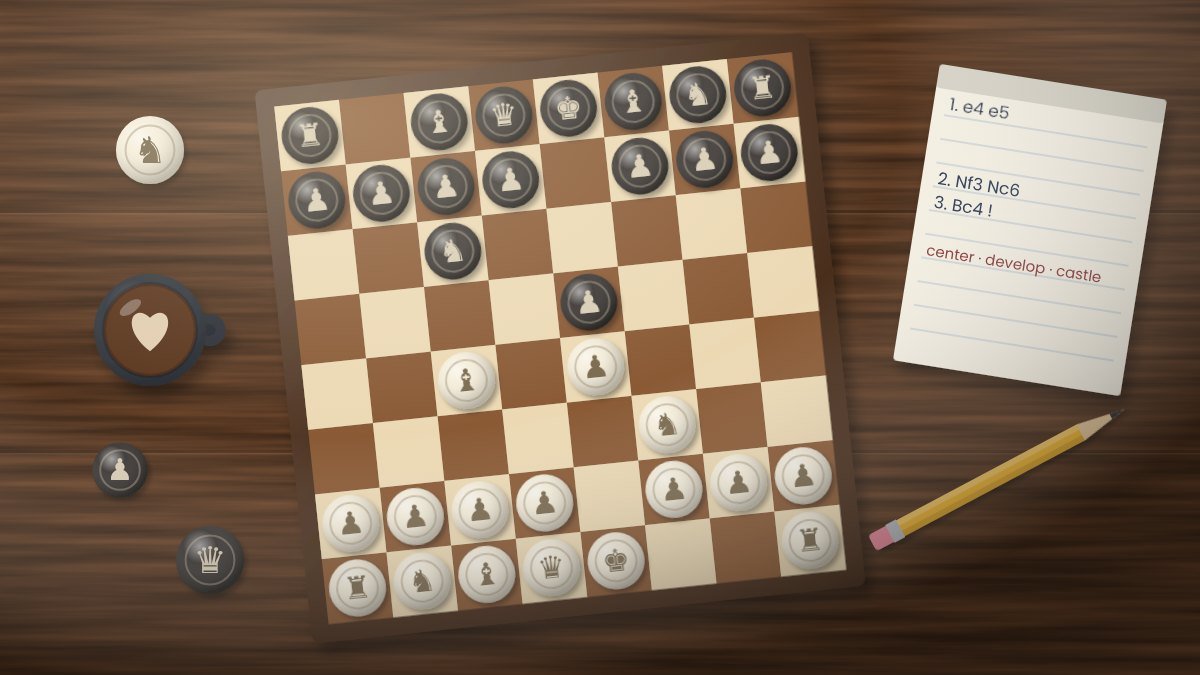
1. e4 e5 2. Nf3 Nc6 3. Bc4
The Italian Game is one of the oldest openings in chess and a perfect first choice. White takes the center with a pawn, develops a knight that attacks Black's e5 pawn, then places a bishop on c4 aiming at f7, a weak square near Black's king. From here, White usually castles and continues developing. It follows every principle on the list.
The London System
1. d4, then Nf3, Bf4, e3 and c3
The London System is less about specific moves and more about a setup. White plays the same structure against almost anything Black does, which makes it easy to learn. It leads to solid positions where you understand the plans, so it is popular with players at every level.
Openings for Black
Against 1. e4: play 1... e5
Answering 1. e4 with 1... e5 is the most classical approach. It stakes a claim in the center and opens lines for your bishop and queen. If White plays the Italian Game, you can respond with 3... Bc5 (the "Giuoco Piano") or 3... Nf6 (the "Two Knights Defense"), both of which develop pieces naturally.
Against 1. d4: play 1... d5
Meeting 1. d4 with 1... d5 mirrors White's center pawn. If White plays 2. c4, the Queen's Gambit, you can calmly reply 2... e6 (the Queen's Gambit Declined), protecting your center and preparing to develop your dark-squared bishop and castle.
Common beginner mistakes to avoid
- Moving too many pawns. Pawn moves can create weaknesses. In the opening, focus on one or two center pawns and then develop pieces.
- Grabbing material without thinking. Free pawns are sometimes traps. Check what your opponent gets in return.
- Ignoring your opponent's threats. Before every move, look at what your opponent's last move attacks.
- Falling for the four-move checkmate. In "Scholar's Mate," White's queen and bishop attack f7. Protect it by developing your knight to f6 and keeping an eye on that square.
How to keep improving
- Pick one opening for White and one defense for each of 1. e4 and 1. d4. Play them consistently.
- Review your games. Free tools on major chess websites show where you went wrong.
- Solve tactics puzzles. Most beginner games are decided by tactics, not openings.
- Learn ideas, not moves. When you understand why a move is played, you can find good moves even when your opponent surprises you.
The bottom line
Good chess openings come from good habits: control the center, develop your pieces, castle early and keep your queen patient. Start with the Italian Game or London System as White, answer with classical center pawns as Black, and let your understanding grow from there. Memorization can come later. For now, play, have fun and learn from every game.