How to Solve Sudoku: Strategies From Beginner to Advanced
Learn how to solve Sudoku step by step, from basic scanning and pencil marks to naked pairs and X-Wing. Clear examples for beginners and improving solvers.
In this guide
Sudoku looks like a math puzzle, but it does not require any math at all. It is a logic puzzle that uses numbers as symbols. Once you learn a few techniques, even "hard" puzzles become a calm, satisfying way to spend 20 minutes.
The rules
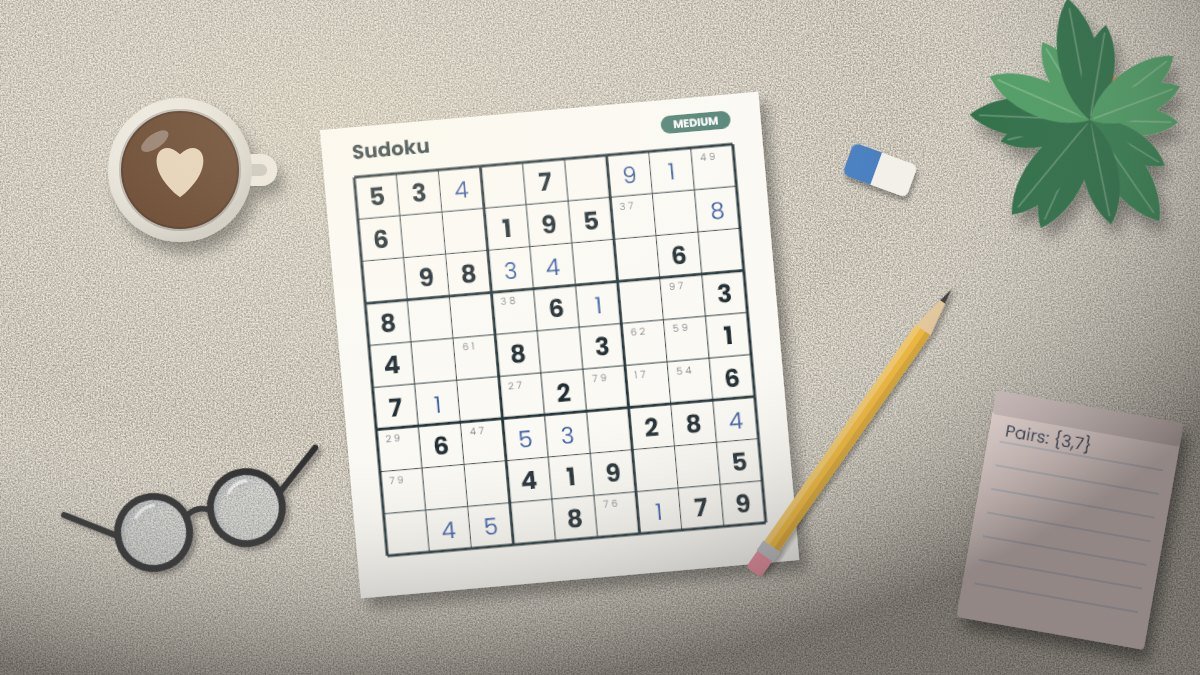
A standard Sudoku grid has 81 cells arranged in nine rows, nine columns and nine 3×3 boxes. Some cells start with numbers already filled in. Your job is to fill every empty cell so that:
- Each row contains the digits 1 through 9 exactly once.
- Each column contains the digits 1 through 9 exactly once.
- Each 3×3 box contains the digits 1 through 9 exactly once.
A well-made Sudoku has exactly one solution, and you should never need to guess.
Beginner strategies
Scanning (cross-hatching)
Pick a digit, say 5. Look at a 3×3 box that does not contain a 5 yet. Then scan the rows and columns that pass through that box. Every row or column that already has a 5 rules out the cells in that line. If only one cell in the box is left, that is where the 5 goes.
Work through digits 1 to 9 this way, box by box. On easy puzzles, scanning alone can solve the entire grid.
Last remaining cell
If a row, column or box has eight digits filled in, the missing one is obvious. It sounds simple, but it is easy to overlook when you are focused on scanning. Make a habit of checking for nearly complete lines.
Single candidate
Look at a single empty cell and list which digits are already in its row, column and box. If eight of the nine digits are ruled out, the remaining digit must go there.
Intermediate strategies
Pencil marks (candidates)
When scanning stops working, it is time to write small candidate numbers in each empty cell, listing every digit that could legally go there. Many solvers write them in the corners of the cell. Once your candidates are in place, patterns appear that you cannot see otherwise.
Naked single
After pencil-marking, any cell with only one candidate left is solved. Fill it in, then erase that digit from the candidates in the same row, column and box.
Hidden single
Sometimes a digit appears as a candidate in only one cell within a row, column or box, even if that cell has other candidates too. That digit must go in that cell.
Naked pairs
If two cells in the same row, column or box both have exactly the same two candidates, for example {3, 7}, then those two digits must go in those two cells. You can erase 3 and 7 from every other cell in that unit. The same logic works for three cells sharing three candidates, called naked triples.
Pointing pairs
If all the candidates for a digit within one box fall in a single row or column, that digit must appear in that line within the box. You can then remove it from the rest of that row or column outside the box.
Advanced strategies
X-Wing
Find a digit that appears as a candidate in exactly two cells in each of two different rows, and those cells line up in the same two columns. They form the corners of a rectangle. The digit must occupy two opposite corners, so you can remove it from every other cell in those two columns. The same pattern works with columns and rows swapped.
Swordfish
A Swordfish is an X-Wing extended to three rows and three columns. It is rarer and harder to spot, but it follows the same logic.
XY-Wing
This technique uses three cells with two candidates each, in a pattern like {A, B}, {A, C} and {B, C}. When arranged correctly, any cell that sees both the {A, C} and {B, C} cells cannot contain C. It sounds complicated, but with practice you start to see these patterns.
A solving routine that works
- Scan for easy placements using every digit 1 through 9.
- Check nearly complete rows, columns and boxes.
- Add pencil marks once scanning stalls.
- Look for naked and hidden singles, then pairs and pointing pairs.
- Try advanced techniques only when the simpler ones run out.
- After each placement, update your candidates. A single new digit often unlocks several more.
Common mistakes
- Guessing. If you feel you have to guess, you have missed a technique. Step back and rescan.
- Forgetting to update candidates. Stale pencil marks lead to errors.
- Rushing. Sudoku rewards calm, steady attention. Speed comes naturally with practice.
Choosing the right difficulty
| Level | What you will need |
|---|---|
| Easy | Scanning and last remaining cell |
| Medium | Pencil marks, naked and hidden singles |
| Hard | Pairs, pointing pairs, triples |
| Expert | X-Wing, Swordfish, XY-Wing and beyond |
The bottom line
Sudoku is a puzzle of patience, not math. Start with scanning, move to pencil marks when you get stuck, and add one new technique at a time. Before long, puzzles that once looked impossible will feel like a relaxing daily ritual.