7 Logic Puzzles That Give Your Brain a Good Workout
Discover seven classic logic puzzles, from KenKen and Nonograms to logic grids, with simple explanations of how each one works and tips for getting started.
In this guide
Logic puzzles are some of the most satisfying ways to unwind. Unlike trivia, you do not need to know anything in advance. Every puzzle gives you all the information you need, and the challenge is to reason your way to the one correct answer. Here are seven classics worth trying, with a quick guide to how each one works.
1. Logic grid puzzles
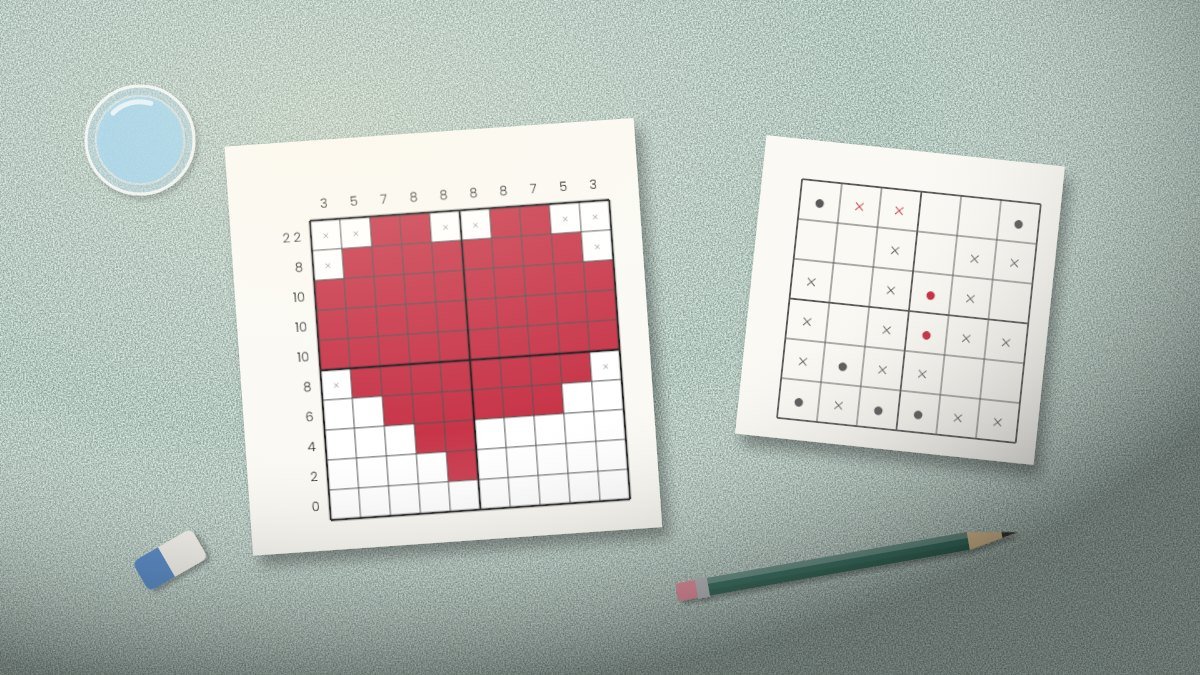
How it works: You are given a short story and a list of clues, such as "The person who owns the cat lives next to the teacher." Using a grid, you mark which combinations are true or false until every detail is matched.
Why you will like it: It feels like solving a small mystery.
Getting started: Use X marks for "no" and dots for "yes." When you mark a "yes," you can immediately fill in "no" for every other option in that row and column.
2. KenKen
How it works: Like Sudoku, each row and column must contain each digit once. The grid is divided into outlined groups called "cages," and each cage shows a target number and an operation, like "12×" or "3−." The digits in that cage must produce the target using that operation.
Why you will like it: It adds a gentle arithmetic layer to Sudoku-style logic.
Getting started: Begin with single-cell cages, which give you a number outright, and with cages whose target has only one possible combination.
3. Nonograms (Picross)
How it works: Numbers beside each row and above each column tell you how many filled squares appear in a line, and in what groups. Using those clues, you shade squares until a hidden pixel picture appears.
Why you will like it: The reveal of the final image is genuinely delightful.
Getting started: Look for rows where the clue is large compared to the row length. Overlapping possibilities show you squares that must be filled no matter where the group sits.
4. Kakuro
How it works: Often called a "crossword with numbers," Kakuro has a grid of white cells with clue numbers. Each run of cells must add up to its clue, using digits 1 through 9 with no repeats in a single run.
Why you will like it: It blends quick mental addition with logic.
Getting started: Memorize a few "unique sums." For example, two cells that add to 3 must be 1 and 2, and two cells that add to 17 must be 8 and 9.
5. Slitherlink
How it works: You draw a single continuous loop around a grid of dots. Numbers inside cells tell you how many of that cell's four sides are part of the loop.
Why you will like it: It has elegant rules and surprising depth.
Getting started: Start with zeros (no sides used) and threes in corners, which often force specific lines.
6. Hashi (Bridges)
How it works: Islands with numbers are scattered across a grid. You connect them with horizontal or vertical bridges so that each island has as many bridges as its number. You can draw up to two bridges between the same pair of islands, bridges cannot cross, and every island must be connected in one network.
Why you will like it: It is visual, tidy and calming.
Getting started: Look for islands with large numbers and few neighbors. An "8" in the middle of four neighbors needs double bridges in every direction.
7. Minesweeper-style puzzles
How it works: Numbers tell you how many hidden mines touch a square. Using deduction, you work out which squares are safe. The puzzle versions found in books and apps are carefully designed so they can always be solved by logic alone.
Why you will like it: Familiar rules, but no guessing.
Getting started: Look at pairs of neighboring numbers. Comparing what they share often reveals which squares are safe.
Comparing the puzzles
| Puzzle | Main skill | Good for |
|---|---|---|
| Logic grids | Deduction | Mystery lovers |
| KenKen | Arithmetic and logic | Sudoku fans |
| Nonograms | Pattern recognition | Visual thinkers |
| Kakuro | Addition | Number lovers |
| Slitherlink | Spatial reasoning | Pen-and-paper fans |
| Hashi | Spatial planning | Calm, visual solving |
| Minesweeper puzzles | Deduction | Quick sessions |
Where to find logic puzzles
Logic puzzles are widely available in newspapers, puzzle magazines, bookstore puzzle books and puzzle apps. Many apps let you start at easy levels and gradually increase difficulty, and some offer hints when you get stuck.
The bottom line
Logic puzzles offer a rare kind of mental break: focused, quiet and always solvable. Pick one style that appeals to you, start with the easiest level and enjoy the small thrill of each deduction. You may find yourself reaching for a puzzle instead of your phone at the end of the day.