10 Word Games to Play When You Need a Mental Break
Need a quick mental reset? These word games, from daily puzzles to classic pen-and-paper games, are easy to start and perfect for short, relaxing breaks.
In this guide
Sometimes the best break is not doing nothing. It is doing something different. Word games engage a playful part of your brain, take only a few minutes and leave you feeling refreshed rather than drained. Here are ten options, from daily puzzles to classic games you can play with nothing but a pencil.
Daily word puzzles
1. Wordle
The famous five-letter guessing game gives you six tries to find the day's word. Colored tiles show which letters are correct, misplaced or absent. It is available free on The New York Times website and takes just a few minutes, which makes it a perfect coffee-break habit.
2. Spelling Bee
In this New York Times puzzle, seven letters are arranged in a honeycomb. You make as many words as you can that include the center letter, and you can reuse letters. It is relaxing because there is no pressure to find every word; you just play until you are satisfied.
3. Connections
Connections gives you 16 words and asks you to sort them into four groups of four based on hidden links. It rewards lateral thinking and is especially fun to compare with friends.
Classic pen-and-paper games
4. Hangman
The classic guessing game for two or more players needs only a pencil and paper. One person chooses a word and draws blanks for each letter; the others guess letters one at a time. Great for kids and travel.
5. Ghost
A spoken word game for two or more people. Players take turns adding a letter to a growing fragment of a word. If you complete a real word (usually of four letters or more), or create a fragment that cannot become a word, you lose the round. It is clever, fast and needs no materials at all.
6. Word Ladder
Change one word into another by altering a single letter at a time, making a real word at each step. For example, CAT to DOG might go CAT, COT, COG, DOG. Lewis Carroll popularized this puzzle in the 1870s, and it is still a delightful brain teaser.
7. Categories
Choose a letter and a list of categories, like "fruits," "cities" and "movies." Everyone writes an answer for each category that starts with that letter. Unique answers score points. This is the idea behind the board game Scattergories, but you can play it on any piece of paper.
Tile and board games
8. Scrabble
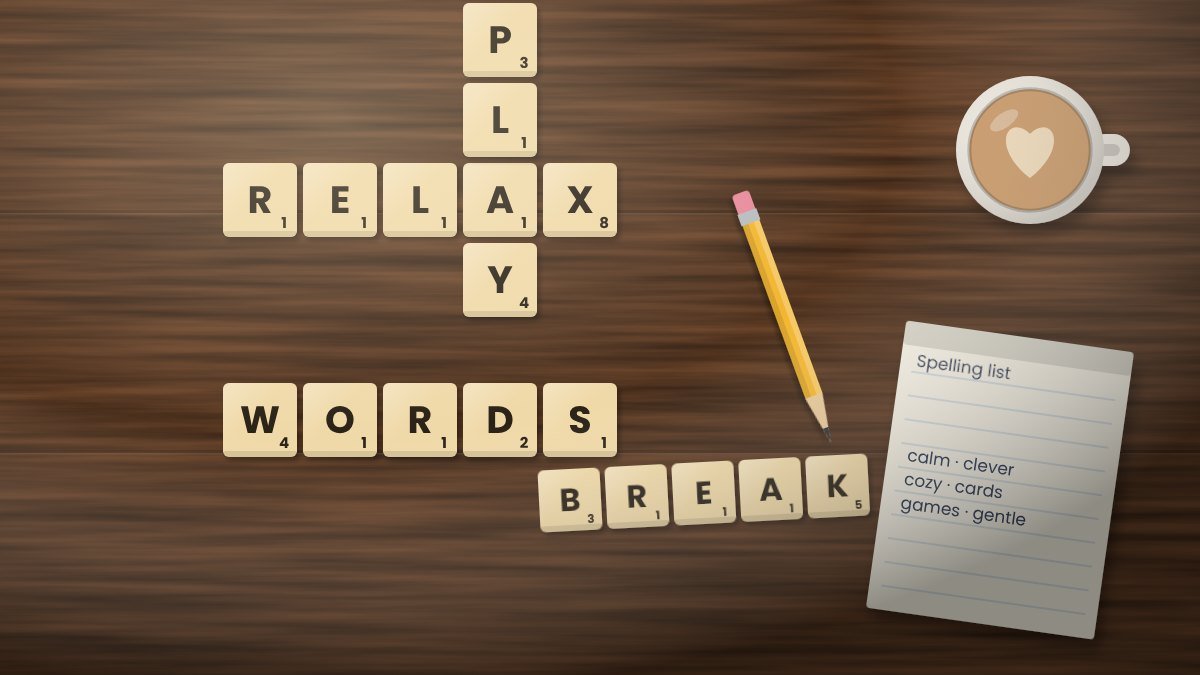
The classic crossword-building game remains one of the best word games ever made. If you want a quick break, play a solo practice game or try to make the highest-scoring word from a random set of seven tiles.
9. Bananagrams
Bananagrams is a fast-paced tile game without a board. Each player builds their own crossword grid as quickly as possible, rearranging words as they go. It plays in minutes and fits in a pocket-size pouch.
Quiet solo option
10. Anagram challenges
Take a long word, such as "relaxation," and see how many smaller words you can make from its letters within five minutes. It is a simple, satisfying exercise you can do anywhere.
Why word games make good breaks
- They are short. Most take five to fifteen minutes.
- They shift your focus. Switching to a playful task can help you return to work with fresh eyes.
- They are social. Many daily puzzles invite friendly comparisons, and pen-and-paper games are easy to share.
- They are low stakes. No one minds if you miss a word in Spelling Bee.
Picking the right game for the moment
| Situation | Try |
|---|---|
| Two-minute coffee break | Wordle or a word ladder |
| Lunch break | Spelling Bee or Connections |
| Waiting with kids | Hangman or Ghost |
| Evening with friends | Bananagrams or Categories |
| Quiet time alone | Anagram challenge or solo Scrabble |
The bottom line
Word games are small, portable joys. Keep one or two in your daily routine, use them to reset between tasks, and do not worry about winning. The point is a few minutes of playful focus that leaves you a little lighter than before.